Sunday, November 20, 2011

Delhi in a Day (International Competition film)


Delhi in a Day


Dir: Prashanth Nair
/Hindi|English/88min/2011

MORE ABOUT CAST AND CREW

Genre :


Comedy
Drama

Artists (Cast) :
Lee Williams
Lillete Dubey
Victor Banerjee
Kulbhushan Kharbanda

Producer :
Prashant Nair
Chintu B. Mohapatra

Director :
Prashant Nair

Production Company(s) :
Nomad Productions PLC

Story Writer :
Prashant Nair

Cinematographer :
Eun-Ah Lee

Executive Producer :
Kumar C Dev

Casting Director :
Andrea Clark

Plot Summary:
The staff of a Delhi household are given one day to return a British traveler's stolen money


Review
by Margaret Julian Alexander

This film is about a typical, rich Delhi household which includes six domestic helpers, and how the arrival of a ‘foreign’ guest brings out the real human beings in this happy-go-lucky bunch. It is also about stereotypes and prejudices, not only in India but also about India.
You find the gang amusing although it is difficult to connect with them on a personal level as there are so many characters. But you definitely fall in love with some of them, like Rohini, the vivacious maid, the wise and witty grandfather, and Jasper, the foreign visitor.
Though this is not a nonsensical comedy, its punches are amusing. Contrary to perception, Delhi In A Day is not a dark comedy but it does have a message: Who says you have to make cheesy films to make people laugh?
Its original music score by the brilliant Mathias Duplessy sets the mood just right. This film offers some beautiful shots and neat cinematography. And, finally, Prashant Nair has roped in some amazing talent from the National School of Drama and the performances are not disappointing.

Delhi In A Day - Official Trailer


Some news


Body/Vucut (International Competition film)


More about film

Review by edgarchaput


What your body means to you and what it means to those around you may be entirely different ideas. Each party will influence one another to a degree, but whose influence shall carry over more, yours, or that of the public? Beware if the pressure of the latter group gains the upper hand, for suddenly your life may be lived not under the conditions you want, but under societal pressures. But where exactly are the boundaries of this pressure and how can one overcome it? It is even possible? The more important question remains: do you respect yourself enough just the way you are? Turkish director Mustafa Nuri unabashedly dives into the delicate, sensitive issue of self image in some provocative ways for his directorial debut, Vucut, which played at the FFM in Montréal.


The drama begins immediately in Vücut, as in the very first scene Leyla (Hatice Aslan), and aging porn star, is desperately knocking (read: slamming) on the door to her former business partner and producer’s apartment. Dressed like a hooker but behaving like a women pleading for her life, Leyla simply wants in. Evidently something has happened between the two, but Yilmaz (Cengiz Bozkurt), the producer, is not answering. At the sound of police sirens, Leyla flees. Shortly after, Yilmaz arrives at Leyla’s home, finds his prized but bruised actress in her room and attempts to make up for earlier by proposing that they make one final film together. He’ll find a great young chap to co-star, she will earn some more money with a new bank account and retire rather comfortably. She agrees. Enter Izzat (Hakan Kurtas), a 20 year old, very handsome young man living with his obese mother (Seyla Halis) and younger sister in a small apartment. While Izzat may look attractive, he is not much of a gentleman, easily flustered, very temperamental and lazy. His mother insists that he get a job, even going so far as to locating job interviews for him, ungrateful as he may be. One thing leads to another and Izzet finds himself on the shooting set of Yilmaz’s latest porn show, which is essentially a tiny kitchen room. The scene goes through terribly, so much so that Yilmaz is enraged by Izzet’s incompetence and fires him on the spot, but the youth is captivated by Leyla. Following this tumultuous event, he does everything he can to be a part of her world...

Vücut is a stunningly multilayered film, involving several subplots, each relating to the overall theme of body image. Virtually every character in the film, be they one of the principal starts of the show or merely supporting members who appear for precious few minutes, brings a different dimension to the discussion. There are so many large and small threads Vücut juggles with that it almost becomes difficult to remember them all, but suffice to say that all earn their place in the story and help drive home the movie’s ideas, which are in fact more like challenges than any genuine attempts in talking down to the audience about how people should be respectful of everyone regardless of body types. People should know that anyhow, so why would the film spend time reiterating the obvious? Rather, Mustafa Nuri’s calculated choice to make each character three dimensional, complex and fully realized as possible, which includes a long line of strengths and weaknesses for each, means that the audience gets to see ‘life’ at work. The social setting itself, lower middle class, is equally important in dictating some of the dynamics that erupt as the story moves along. None of the characters featured in the movie are multimillionaires, each has some important things to think about with regards to their future.


Director Nuri is unafraid in his storytelling, demonstrating full capabilities in developing a theme through pure character interactions. The exploration of these individuals, from Izzet, to his mother, to Leyla, to Leyla’s sister, to Izzet’s bodybuilding friend, to Yilmaz, to Yilmaz’s attractive but sexual interested wife, all of it adds fascinating layers to the discussion of body image and the prejudices which can easily arise to cause friction, embarrassment, rage, depression, overconfidence, exclusion, inclusion, etc. Despite offering a few humorous scenes, mostly during the horrendous porn movie shoot, Vucut plays things as straight as possible. Since most of the people involved are coming from dark places, whether by circumstances, as in Leyla’s case, or by their own creation, as in Izzet’s case, the film is a rather tough drama. What its story does incredibly well is have the viewer understand the consequences of prejudice. How those subjected to it react as how do its perpetrators behave. It is not as though audiences are oblivious to the topic, we make up ideas of people based on how they look almost all the time. Vücut confronts this practice head on and does not let up until the bitter end. The mere fact that it features a group of leading characters like a good looking young man, an porn star in her late forties, a fat woman and a fat little girl is indicative enough of the sort of cinematic territory the film is willing to venture into. Those brief descriptions alone conjure up thoughts in people’s heads, not just with regards to how those people might look, but also about why they might look that way, which in turn prompts people to start guessing, for good or ill, about their lifestyles and who they are.Vücut challenges that practice in an unforgiving manner.


Punctuated by the study of prejudice are the very real, very emotional ties between all the people we are seeing on screen. At the forefront of these relationships is that sought after by the young Izzet, played wonderfully by Hakan Kurtas, who stars in a movie for the very first time (just like his character in the film itself). He and Leyla form an odd couple, At first, Leyla wants very little to do with this brash little boy. She is already wrestling with the very thought that her life has gone to waste. As her sister puts it, Yilmaz used her up during the best years of her life. Those years have now passed and Leyla is left with the notions of what could have been. Izzet is smitten by her, which is immediately comes as something of a shock. Not that actress Hatice Aslan is unattractive, but that he could go for so many girls of his age. Yet, his devotion to Leyla functions as the lone attempt in the film to destroy a prejudice. Leyla is a washed up porn star is slowly losing her looks, but Izzet wants nothing more than to be with her. The irony of the entire situation is that by inadvertently trying to go beyond a boundary set by a prejudice (or several prejudices, one other being the odd sight of a young, twentysomething going out with another person in her late forties), their time together creates as much tension as existed in their lives before. Leyla is fighting depression, thus causing a slavish devotion to a collection of pills, Izzet is still the easily irritable fellow he was before, and so when Leyla is not the mood to do what he likes, well, things don’t go so well. It certainly makes for an interesting way to this plot thread to develop seeing how things to do not go as happily as one might like. Then again, both are from worlds so far apart, because of culture and age, that one must stop and think that has to be a better way to break down a boundary. Maybe. Then again, maybe not. Special mention should go to Hatice Aslan, who is spellbinding in Vücut. Her vulnerability is infinitely watchable. The scenes in which her sister comes to visit are fantastic in how they award her some happy moments and we get to see Aslan offer beautiful smiles. Those smiles leaves a lasting impression since they are the few we have privy to in the picture. A haunting performance, one that perfectly captures the story of a broken soul.

Vücut is easily one of the more powerful films to come out in 2011. Turkish films do not make it out to North America very much, thus doubling the privilege felt by having seen Mustafa Nuri’s terrific drama.

Vucut trailer


HELPFUL LINKS
http://en.wikipedia.org/wiki/Cinema_of_Turkey


Black Blood (International Competition film)


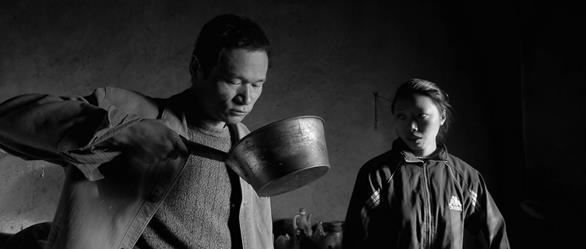
The bleakness of the harsh rural landscape is impressively captured.


Director:Miaoyan Zhang
Screenplay:Miaoyan Zhang, Yang Zhihong
Music:Andy F. Butler, Anette Bauer
Cinematography:Miaoyan Zhang
Editing:Miaoyan Zhang
Cast:Danhui Mao, Mengjuan Liu, Yingyang
Awards:Nagroda NETPAC – MFF w Rotterdamie / NETPAC Award – IFF Rotterdam (2011)


Miaoyan Zhang — born in Manchuria in 1964 and growing up during the Culture Revolution, ZHANG Miaoyan barely had a chance to see movies. In the 90s he got an opportunity to study art at UC Berkeley which enabled him to watch foreign movies nonstop. Miaoyan started writing stories about contemporary China. None of them were published due to state censorship.

Plot
As the dark smoke of the factory hits Xiaolin’s throat, he knows he is getting close. Up ahead he sees the rattling old truck, at the edge of the crumbling Great Wall and the queue of villagers, eager to sell their blood. Xiaolin decides to returns to sell his blood in order to pay for his daughter's tuition. And soon his wife joins him. They decide to start a blood collecting business named Ali-Baba. They start to make considerable profits and their once empty courtyard soon becomes the bustling home to a large herd of sheep. Although their lives appear to be going well, it is a matter of time before disaster strikes.
They both fall victim to an incurable disease. Xiaolin and his wife Xiaojuan are only two of many thousands that are infected with HIV each year, selling their blood. As the couple fight for their lives, Xiaolin goes from door to door to try and get their daughter Ying adopted. Finally, Xiaojuan passes away, leaving Xiaolin with an deserted blood collecting station and a hungry daughter. But life still goes on...


Review
By Mark Adams

Miaoyan Zhang’s beautifully shot bitter drama Black Blood is a simple, but grippingly absorbing, story of an impoverished Chinese family in remote northwestern China who resort to selling their blood as the only way to try and survive. The film, which premiered at the Rotterdam Film Festival, is Zhang’s second film and received post-production support from the festival’s Hubert Bals Fund.
Shot in widescreen black-and-white – apart from two atmospheric colour sequences of factories billowing out smoke and fumes – the film is structured in a simple linear fashion, but Zhang makes great use of his set-ups, allowing the strange eroded landscape and the dusty village locations to tell the story as much as his protagonists.
Couple Xiaolin (Danhui Mao) and his wife Xiaojuan (Mengjuan Liu) are struggling to make ends meet, with water in short supply and needing money to pay for their daughter’s tuition. Xiaolin decides to sell his blood to try and raise funds, and before long both husband and wife are selling blood.
They decide to start a blood collecting business – named Ali-Baba – and before long he is wearing a suit and making the grand gesture of buying a toilet for the house. But when both become infected with HIV their dreams crumble around them, with Xiaolin eventually even going from door to door to try and get their daughter adopted.
The bleakness of the harsh rural landscape is impressively captured, as is the harshness of the life the family lead. The actual blood-giving is never explicitly captured on film – instead Xiaolin simply wanders towards a road where he patiently waits for a man driving a tractor to arrive. It is here – in the middle of nowhere and with no medical backup – the blood is bought and sold.
Trailer

At the end of it all/Abosheshey (International Competition film)

A Stone’s Throw Away/A Tiro de Piedra (International Competition film)


A tiro de piedra | A Stone's Throw Away


Sebastian Hiriart (Mexico, 2011). 117 mi
Jacinto is a goat-herder in a part of Mexico that looks quite desolate and inhospitable. There aren’t many other people around. His life seems quite boring and lonely. The bells the goats wear do make a nice musical clang but that’s hardly exciting. Sometimes, while looking after the goats, Jacinto falls into a reverie where he is struggling through a pine forest that’s deep in snow – he looks exhausted, like he’s on his last legs. But then he finds a large wooden box buried in the snow – a treasure chest, maybe? When he finds a keychain in the shape of a barn surrounded by trees, stamped with the name of a town in Oregon, he takes it as “a sign” that he should go there, and that’s just what he does, though not without many trials and tribulations. On the way, some people help him, and some people take advantage of him - that’s the way real life is, for many of us. Jacinto survives through a combination of good nature, stubbornness and stoicism. His jutting chin seems like the physical manifestation of hat stubbornness.


Director


Sebastián Hiriart started his film career as a child-actor. He has worked as a director, actor, photographer, and camera operator on various films and TV shows. In 2001 he attended a film workshop at New York Film Academy. A tiro de piedra is his first feature film


Story

Jacinto Medina is 21 years old and lives a simple, boring life as a shepherd in northern Mexico. He experiences visions, potentially of things to come, or an alternate life. When he finds a key with an engraved address in Oregon, USA, he is certain it is a sign and decides to leave. Driven by the urge to seek the meaning of his strange visions, he sets out on a journey to cross the US-Mexico border.
More about film

Mexico, Drama, 2010
118 min, 35mm, Color
Spanish with English subtitles

Producer: Sebastián Hiriart
Production Companies: Galopando Films
Screenwriter: Gabino Rodríguez, Sebastián Hiriart
Cinematographer: Sebastián Hiriart
Editor: Pedro Gómez García
Sound Design: Matias Barbieris, Gustavo Bellon
Music: Emiliano Motta, Emiliano Gonzalez de Leon
Cast: Jacinto Medina, Gabino Rodríguez

Some Reviews

A Stone Throw Away

A tiro de piedra

(Mexico)


With: Gabino Rodriguez, Monserrat Angeles, Rogelio Medina, Alejandra Espana, Julian Silva, Randy Watkins, Janice Reese. (Spanish, English dialogue)
A Galopando Cine production, in collaboration with Verde Espina Studios. Produced by Ximena Hiriart, Sebastian Hiriart. Directed by Sebastian Hiriart. Screenplay, Gabino Rodriguez, Sebastian Hiriart.
A Mexican hick with only a dream to go on wends his way to Oregon in Sebastian Hiriart's debut feature, "A Stone Throw Away." Well made on a shoestring, the pic says nothing new about the illegal-immigrant experience, though the current debate on the topic could offer platforms for exploitation. Still, given the large number of well-worn situations here, Hiriart needs to engage more thoughtfully with the question: Is a cliche still valid film fodder when it reflects the truth? While programmers throw that one about, "A Stone" is likely to roll around south-of-the-border sidebars.
Shepherd Jacinto (Gabino Rodriguez, "Perpetuum Mobile") is bored with herding goats in the arid scrub of central San Luis Potosi state. He finds an incongruous 4-H Club Oregon keychain and takes it as a sign that his dream, of uncovering treasure in a snowbound forest, will come true. Stealing money from his sympathetic uncle, Jacinto embarks on the journey north; he gets robbed, enjoys the company of a kind-hearted prostitute and encounters the usual assortment of well-meaning folk and scam artists. Good framing and solid lensing, plus Rodriguez's thesping strengths, hold interest.
Camera (color, HD-to-35mm), Hiriart; editor, Pedro G. Garcia; music, Emiliano Motta, Emiliano Gonzalez de Leon. Reviewed at San Sebastian Film Festival (Latin Horizons), Sept. 19, 2010. Running time: 94 MIN.


Malayalam Cinema Today

Malayalam Cinema Today
1. Akam/Palace in Bloom
Dir: Shalini Usha Nair/Malayalam/97min/2011

2. Karmayogi
Dir: V.K.Prakash/Malayalm/11min/2010

3. Khaaddama/Expatriate House Maid
Dir: Kamal/Malayalam/107min/2010

4. Pakarnattam
Dir: Jayaraj/Malayalam/98min/2010

5. Pranchiettan and the Saint
Dir: Ranjith/Malayalam/120min/2010

6. Sankaranm Mohananum
Dir: T.V. Chandran/Malaylam/110min/2011

7. Traffic
Dir: Rajesh Pillai/Malayalam/116min/2011


Indian Cinema Now

One of the great attractions of IFFK

Indian Cinema Now
1. Aadukalam/Arena
Dir: Vetri Maran/Tamil/120min/2011

2. Azhagarsamy's Horse
Dir: Susindran N./Tamil/122min/2011

3. Baboo Band Party
Dir: Rajesh Pinjani/Marathi/127min/2010

4. Chaplin
Dir: Anindo Bandopadhyay/Bengali/137min/2011

5. Handover
Dir: Saurabh Kumar/Hindi/73min/2011

6. I want to be a Mother/Mala Aai Vhhaychyl
Dir: Dir: Adv. Samruoddhi Sanjay Porey/Marathi/115min/2010

7. Naukadubi/Kashmakash
Dir: Rituparno Ghosh/Bengali/135min/2011